EXERCHAIR: Innovation in motion #

This blogpost presents a whitepaper on the EXERCHAIR research project at the Sport Innovation Campus (page in Dutch). The research project focuses on the development of an accessible exergame for wheelchair users. The project is embedded in the Sport Innovation Campus (Howest & Sport Vlaanderen) and builds on existing technologies such as the iPlay setup and the MocapForAll tracking framework. The ultimate goal: to promote physical activity among people with physical disabilities through fun games and inclusive technology.
The perfect match: Movement and fun through exergaming #
The world of sports and exercise is evolving rapidly under the influence of technological innovations. One of the most exciting developments within this trend is the rise of exergames: interactive games that center on physical activity. Players use their bodies to control game characters or complete specific challenges. Imagine a game where you navigate a virtual course through arm movements, or score points by rotating your torso. This combination of physical exercise and gameplay creates an engaging experience where movement no longer feels like an obligation, but like a fun and motivating challenge (Staiano & Calvert, 2011).
For wheelchair users, this technology holds enormous potential. Where traditional sports often come with physical barriers, exergames offer the chance to break through those limits. Through adapted technologies and smart design, exergames can actively engage wheelchair users in movement tailored to their abilities (Gerling et al., 2020).Beyond physical benefits such as improved fitness and muscle strength, exergaming contributes to mental well-being and social inclusion. Research shows that exergaming leads to higher physical activity levels, improved cognitive functions, and stronger social connections (Staiano & Calvert, 2011).
Recent studies also indicate that exergames can reduce feelings of loneliness and social isolation, particularly among populations with less access to traditional sports and activities (Mason et al., 2022). In a society where sedentary lifestyles and isolation are growing challenges, there is an urgent need for innovative, inclusive solutions. Exergames for wheelchair users lower the barriers to physical activity, promote participation, and contribute to building a society where sport and play are accessible to all.
More opportunities for movement: the power of exergames for wheelchair users #
Today, the importance of regular physical activity is more widely recognized than ever, yet the number of people who are insufficiently active continues to grow. For wheelchair users, this challenge is even greater. They often face additional barriers such as a lack of accessible infrastructure, limited mobility options, and social obstacles that prevent them from participating in sports and exercise.
Research from the World Health Organization (2011) shows that people with physical disabilities are up to twice as likely to experience health problems such as obesity, cardiovascular disease, and diabetes compared to those without disabilities. Furthermore, inactivity can worsen mental health issues like depression and social isolation.
International policy initiatives, including the United Nations’ Convention on the Rights of Persons with Disabilities (United Nations, 2016), emphasize the fundamental right to access sports and recreation. In Belgium, this is supported by the Federal Disability Action Plan (Federal Public Service Social Security, 2024) and the Flemish Sport Policy Note (Flemish Government, 2024).
Still, the statistics remain concerning. Research (in Dutch) by Scheerder and Vanlandewijck (2018) shows that more than half of individuals with disabilities are not active in sports, with wheelchair users having the lowest participation rates among all groups. Key reasons include inaccessible sports infrastructure, lack of adapted sports offerings, and feelings of inadequacy.
Exergames can help close this gap. By creating accessible, digital environments adapted to wheelchair users’ abilities, physical activity becomes achievable, enjoyable, and motivating again. Furthermore, exergames can be played individually or in groups, stimulating social connections and participation.
Making exergaming accessible for everyone #
The opportunities that exergames offer to wheelchair users are promising. When the right game concepts and technologies are applied, wheelchair users can seamlessly integrate physical activity into their daily lives in a fun and accessible way. Exergames not only enhance physical health, but also improve cognitive skills such as reaction time and coordination, while boosting self-confidence and mental resilience (Staiano & Calvert, 2011). Social interaction is another key advantage: playing together fosters connections and mutual support, something especially vital for wheelchair users who face barriers to traditional team sports (Gerling et al., 2020).
Nevertheless, a significant gap remains between the potential and the reality. Many existing exergames are designed with standing players in mind and fail to accommodate the needs of wheelchair users (Gerling et al., 2015). Technical challenges remain too, such as accurately capturing subtle movements of arms, torso, or head. Studies show that trackerless motion capture systems need adjustments to properly recognize movements from a seated position (Farizi et al., 2021). Moreover, the diversity within the wheelchair user community is vast. Games must therefore offer flexible difficulty levels and value different types of movements (Mason et al., 2022).
What works? Keys to successful and inclusive exergames #
When designing exergames that truly engage and support wheelchair users, several critical success factors must be considered.
By paying close attention to these success factors, we can ensure that exergames are not only accessible but also genuinely inspiring, activating, and connecting.
First and foremost, the technology used must be capable of reliably capturing subtle and varied movements. This means that systems should not only detect large movements but also smaller rotations of the torso, head, or arm movements from a seated position (Farizi et al., 2021).
In addition to technological refinement, it is essential to prioritize inclusive design from the very beginning. Exergames should be intuitive and accessible to a wide range of users. This can be achieved by offering simple navigation structures, clear visual cues, and alternative control options, such as head or arm gestures. Applying universal design principles ensures that accessibility is embedded at the core of the design (Gerling et al., 2015).
The gameplay itself must be developed in such a way that players with varying physical abilities can participate on an equal footing. This means offering flexible difficulty levels and ensuring that success depends not only on speed or strength but also on precision, rhythm, or strategy. Providing a variety of game objectives and interactive reward systems can significantly boost motivation and enhance the overall gaming experience (Mason et al., 2022).
Another important aspect is the social character of exergames. By offering multiplayer options, wheelchair users can play together with others, regardless of physical limitations. Social interaction during gameplay not only increases enjoyment but also fosters a stronger sense of inclusion and community. Studies show that collaboration and competition are powerful motivators for sustained engagement in exergames (Gerling et al., 2020).
Finally, the importance of co-creation cannot be overstated. Actively involving wheelchair users in every stage of the development process ensures that exergames are better aligned with their needs and preferences. Iterative feedback rounds and user testing are essential to create a truly user-driven final product. By paying close attention to these success factors, we can ensure that exergames are not only accessible but also genuinely inspiring, activating, and connecting.
EXERCHAIR: an innovative best practice #
At the Sports Innovation Campus, the ambition to make exergaming more accessible for wheelchair users evolved into a concrete research project: EXERCHAIR. This project exemplifies how technological innovation, scientific research, and user-centred design principles can come together to create truly inclusive solutions.
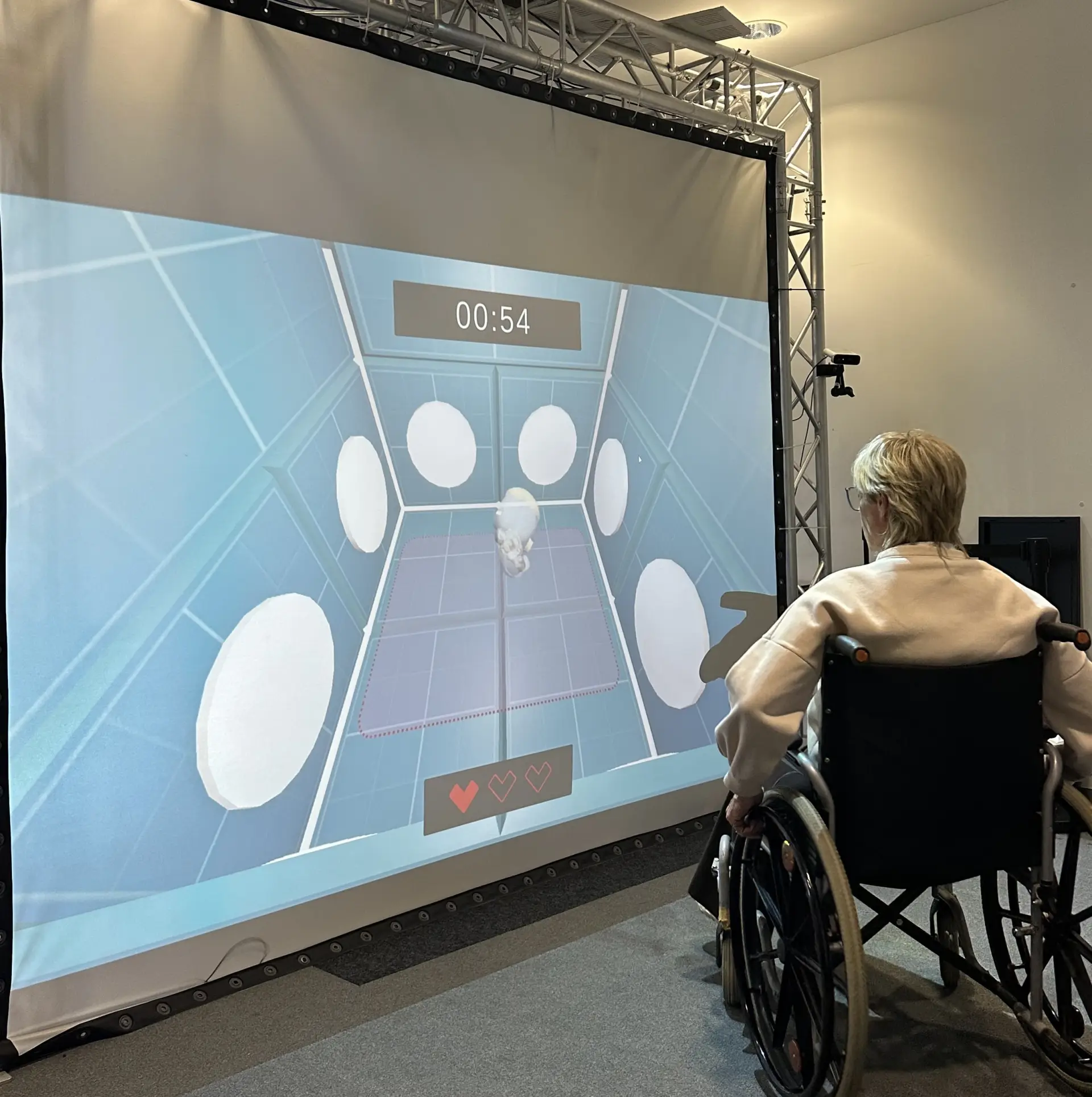
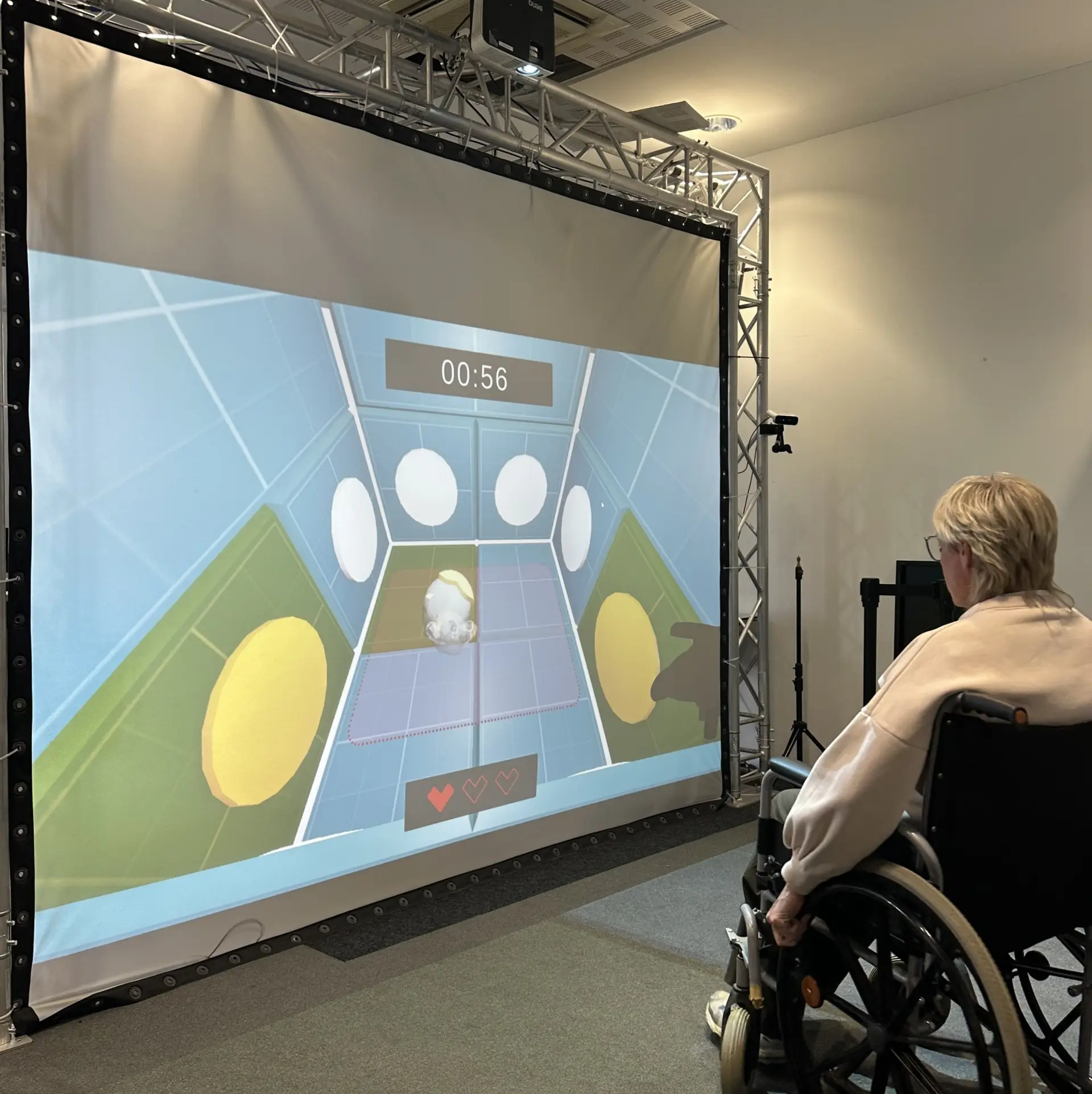
The EXERCHAIR project builds on earlier initiatives such as the iPlay setup and the MoCapForAll framework, both of which promote physical activity through motion capture and interactive gaming. EXERCHAIR specifically focuses on adapting these existing systems for use by people in wheelchairs. This includes refining the motion capture technology to accurately register more subtle movements from a seated position and tailoring the gameplay experience to match the physical abilities of different types of wheelchair users.
The strength of EXERCHAIR lies in its co-creative approach. From the very beginning, wheelchair users, therapists, movement coaches, and technology experts have been closely involved. In collaborative sessions, the main needs and challenges were mapped out:
- What barriers exist in current exergames?
- Which types of movements feel natural from a wheelchair?
- What types of gameplay provide maximum motivation and enjoyment?
These insights form the foundation for the design and testing of new game concepts.
EXERCHAIR also envisions a future where modularity and mobility are key. Whereas earlier setups were tied to fixed locations and specialized equipment, EXERCHAIR aims to make exergaming accessible across a variety of settings — including rehabilitation centers, schools, sports clubs, and even home environments. By utilizing flexible hardware, such as smartphones and tablets, combined with smart tracking software, the project seeks to reach a much broader audience.
The initial results are promising. During testing sessions conducted in collaboration with healthcare and sports organizations, participants not only became more physically active but also developed greater self-confidence and a stronger sense of connection to their environment. These user experiences are systematically analysed and used to continuously refine the technology and enhance the gameplay experience.
With EXERCHAIR, the Sport Innovation Campus is taking an important step towards a more inclusive future — one in which exergaming becomes an integral part of physical activity and health offerings for wheelchair users.
References #
Farizi, F. D., Hoang, T., Bangay, S., & Greuter, S. (2021). Developing design guidelines for virtual reality-based decision-making training for team sports. Extended Abstracts of the 2021 Annual Symposium on Computer-Human Interaction in Play, 61–66. https://doi.org/10.1145/3450337.3483477
Federal Public Service Social Security. (2024). Federaal actieplan Handicap 2021-2024. https://socialsecurity.belgium.be/nl/publicaties/federaal-actieplan-handicap-2021-2024 (PDF)
Flemish Government. (2024). Beleidsnota sport 2024-2029. https://www.vlaanderen.be/publicaties/beleidsnota-2024-2029-sport
Gerling, K., Dickinson, P., Hicks, K., Mason, L., Simeone, A. L., & Spiel, K. (2020). Virtual reality games for people using wheelchairs. Proceedings of the 2020 CHI Conference on Human Factors in Computing Systems, 1–11. https://doi.org/10.1145/3313831.3376265
Gerling, K., Mandryk, R., Miller, M., Kalyn, M., Birk, M., & Smeddinck, J. (2015). Designing wheelchair-based movement games. ACM Transactions on Accessible Computing (TACCESS), 6(2), 1–23. https://doi.org/10.1145/2724729
Inter. (2017). Handboek toegankelijkheid publieke gebouwen. Dossier sportinfrastructuur. https://toegankelijkgebouw.be/NieuwsbriefArchief/DossierSportinfrastructuur
Mason, L., Gerling, K., Dickinson, P., Holopainen, J., Jacobs, L., & Hicks, K. (2022). Including the experiences of physically disabled players in mainstream guidelines for movement-based games. Proceedings of the 2022 CHI Conference on Human Factors in Computing Systems, 1–15. https://doi.org/10.1145/3491102.3501867
Scheerder, J., & Vanlandewijck, Y. (2018). Onderzoek naar de actieve sportdeelname van personen met een beperking in Vlaanderen en het Brussels Hoofdstedelijk Gewest. G-sport Vlaanderen. https://www.gsportvlaanderen.be (PDF)
Staiano, A. E., & Calvert, S. L. (2011). Exergames for physical education courses: Physical, social, and cognitive benefits. Child Development Perspectives, 5(2), 93–98. https://doi.org/10.1111/j.1750-8606.2011.00162.x
United Nations. (2016). Convention on the Rights of Persons with Disabilities. https://www.ohchr.org/en/instruments-mechanisms/instruments/convention-rights-persons-disabilities (PDF)
World Health Organization. (2011). World Report on Disability. https://www.who.int/publications/i/item/9789241564182 (PDF)